

Collector’s Guide
Limited Editions, Artist’s Proofs, and What the Numbers Really Mean
There is something undeniably appealing about the quiet pencil marks in the margin of a print: a signature, a fraction, perhaps the letters AP. They suggest care, scarcity, and a certain closeness to the artist. Yet for many buyers, those small notations remain more mysterious than they should be.
Edition language can sound intimidating at first, but the fundamentals are straightforward. When a print is described as a limited edition, it means that only a fixed number of impressions were produced in that form. A notation such as 42/150 tells a simple story: this is impression number forty-two from an edition of one hundred and fifty.
That numbering matters because it gives shape to the edition. It tells the buyer that the work is not open-ended. There is a defined run. That said, the presence of a number alone does not create importance. Scarcity can add appeal, but it does not automatically create beauty, relevance, or value. The artist, the medium, the condition, and the overall desirability of the image still matter deeply.
Edition details are part of the story of a print, but never the whole story.
One term buyers often encounter is Artist’s Proof, usually abbreviated as AP. Historically, these were impressions set aside for the artist in addition to the standard numbered edition. They sit outside the main sequence, and for that reason they often hold a special fascination. There is a sense, fair or not, that they feel a little closer to the artist’s own circle.
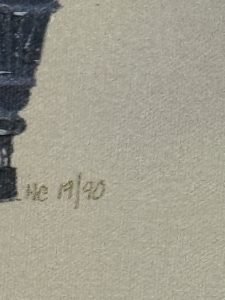
In some cases, an AP may indeed be more sought after. In others, it is simply a variant marking with no dramatic difference in market appeal. The point is not that an AP is always better, but that it should be understood properly. It is part of the edition structure, not a magical category that guarantees superiority.
Another term that appears less frequently, but is worth knowing, is BAT, from the French bon à tirer, meaning “ready to print.” This refers to the final approved proof that sets the standard for the edition. It is the benchmark impression against which the rest of the run is judged. In practical terms, it is usually quite limited and often of particular interest to those who appreciate the production process behind prints.
Buyers may also come across abbreviations such as HC, meaning hors commerce, or “not for trade,” and PP for printer’s proof. These notations indicate impressions outside the main numbered edition, each with its own context. They can be desirable, certainly, but the same principle applies: the notation is meaningful only when understood within the broader structure of the work.
What matters most is not simply whether a print is numbered, but how clearly its edition is presented. Is the medium identified? Is the print hand-signed? Is the total edition size known? Are there artist’s proofs in addition to the numbered run? Is there documentation to support the work’s authenticity and history? These are the quieter questions that experienced buyers tend to ask, and with good reason.
It is also worth remembering that the language of editions can sometimes be used too loosely in the market. “Limited edition” sounds impressive, but a very large edition is a very different proposition from a small, carefully structured one. A hand-signed screenprint is not the same as an open-edition decorative reproduction. Even when the image appears similar, the collecting context may be entirely different.
In the end, these details are not there to make art feel inaccessible. Quite the opposite. They allow buyers to look more closely and to purchase with greater assurance. Once understood, edition marks become less like coded language and more like a useful shorthand—small pencil notes that quietly tell you what, exactly, is in front of you.
Continue Exploring
Ready to discover something you would actually love living with?
Explore original works and limited editions selected for quality, visual impact, and approachability. Whether you are just getting started or searching for a standout piece, our collection is designed to be easy to browse.
Why Buyers Feel Comfortable Here
A more confident way to buy art online
Clearly Presented
Real images, straightforward details, and a transparent buying experience from the start.
Authenticity Support
Certificates of Authenticity and gallery appraisals are available with nearly every piece.
Packed With Care
Secure packaging, insured delivery, and a careful handling process designed for art.
Personal Service
Questions about medium, condition, size, or editions? Reach out before you buy.
